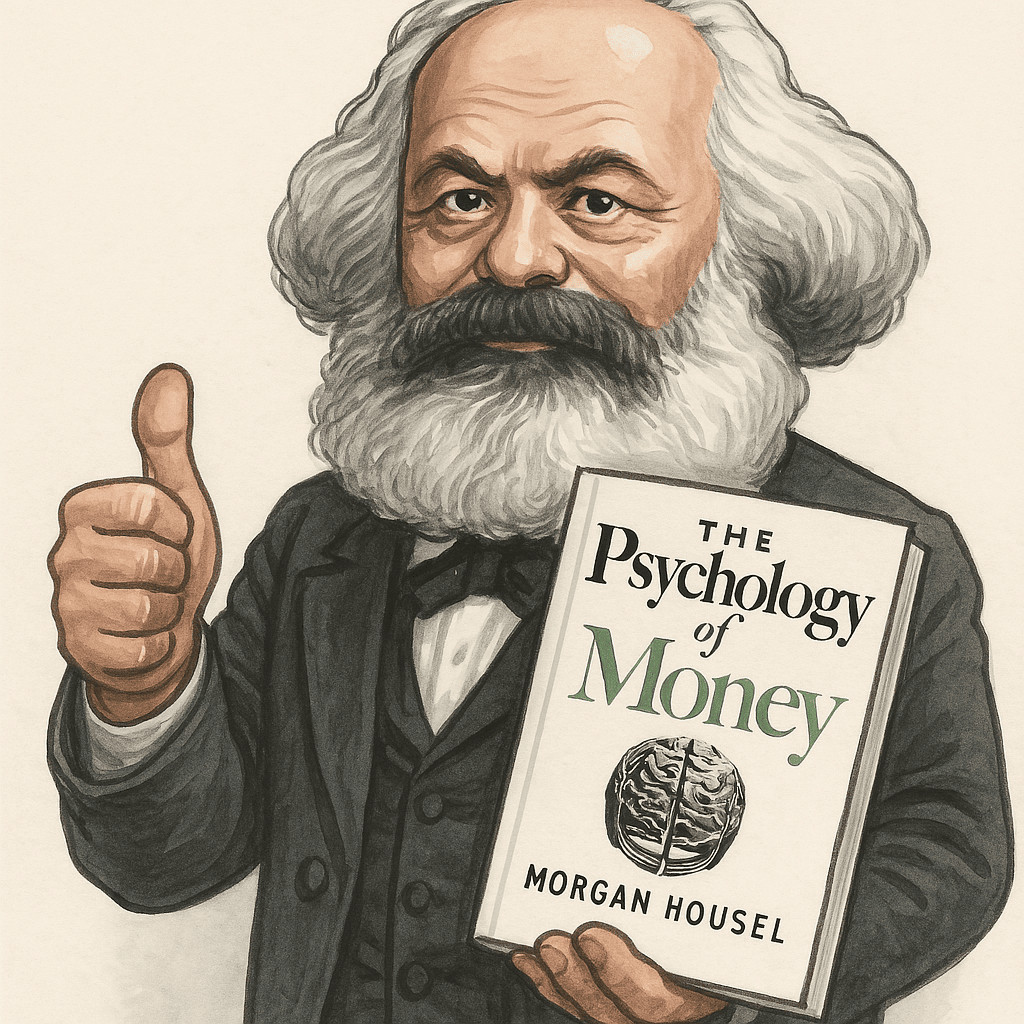
Reviewed by Karl Marx, Revolutionary Theorist, Financial Book Reviewer (Apparently), and Reluctant Enthusiast of Morgan Housel
I was not consulted before being resurrected as a personal finance influencer. One moment, I’m in eternal dialectical slumber; the next, I’m on Goodreads, thumbing through a book with a piggy bank on the cover. And yet—I read it. I annotated it. I laughed. I wept (for the workers). I underlined things with ghostly red ink.
The Psychology of Money by Morgan Housel is a paradox in paperback: a charming bourgeois scripture that teaches financial humility… while floating on a raft of unexamined assumptions about capital, labor, and historical contingency.
But I’ll say this: if you’re going to read any capitalist’s bedtime story, let it be this one.
Where The Pyschology of Money Fails, Magnificently
Housel argues that financial success is often less about intelligence and more about behaviors: patience, humility, self-control.
Of course, this is nonsense spread by the rich. A simple idea to which the masses are drawn giving the illusion of agency. Capitalism is not a behavioral meritocracy. It is a system wherein ownership, not virtue, accumulates. The child of a hedge fund manager may be an absolute turnip yet still receive dividend cheques. The Uber driver with a PhD in physics might “act rich” and still get their card declined at McDonald’s.
The system doesn’t reward discipline. It rewards position. And yet—
Housel tells these stories with such elegance, such warm-blooded humanism, that I found myself nodding along before realizing I was emotionally manipulated by a man who unironically thinks retirement is a solvable puzzle.
The Dangerous Gospel of Frugality
There is, admittedly, something noble in Housel’s admiration for humility and modesty. He tells of secret millionaires living in small homes, driving secondhand Hondas, wearing Costco pants. It is financial stoicism at its finest, Seneca with a Roth IRA.
But what he calls frugality, I call the internalization and acceptance of capital’s scarcities. You cannot renounce consumption as a path to wealth if you were never granted access to comforts in the first place. Austerity is only a virtue to those who have the ability to choose excess. And yet—
These parables are oddly touching. They remind the reader that joy is not always having one’s own helipad. We are reminded that status is a hungry god demanding of tribute. Housel hypothesizes that financial freedom need not come not through more, but rather by focusing on enough. Housel is not preaching greed; he is whispering caution.
The Cult of Compound Interest
Ah yes, compound interest. The capitalist’s sacred cow. I have battled it my entire life. The masses may underestimate its power but Housel recognizes and genuflects before it repeatedly.
He invokes Warren Buffett as financial Bodhisattva. And while he’s not wrong, compound interest is, indeed, a marvel, it is also the ultimate mechanism by which the ruling class grows fat while doing feeding on the work of the masses. Capital makes more capital. The worker toils, the investor rests. The spreadsheet sings. And yet—
There is something undeniably beautiful about the poetry with which Housel explains this. He makes you want to believe. Not just in finance, but in time, in patience, in the idea that something as cold and indifferent as a market can be can be made welcoming through understanding.
I felt… I am loathe to admit… inspired. Briefly. Very briefly. Before remembering that capital has no soul.
The Charming Lies We Tell Ourselves
Housel excels at exposing the myths we hold about money: That we understand risk. That we act rationally. That success can be reverse-engineered. In this, we are kindred spirits.
He writes, “We all do crazy stuff with money, because we’re all relatively new to this.” A sentence so honest it practically glows. I agree with Morgan Housel that the entire system is absurd and that the human animal is gloriously ill-equipped for its ‘logic’. And yet—
Rather than indict the system, Housel chooses to humanize it. This is where we part ways. I would tear down the scaffolding and allow the rot to be removed; Housel suggest better guardrails.
Final Thoughts
This book will not save you. It will not liberate you. It will not explain why your landlord owns seven properties and you split rent with three roommates and a snake named Kyle. But it will comfort you. It will gently, beautifully, and often hilariously guide you toward better decisions within the cage.
And perhaps, just maybe, that’s worth something.
Final Judgment (As All Must Be Judged):
📘 Ideological Content: 2/5 (Steeped in bourgeois mythology)
📘 Readability: 5/5 (Clear as a spring-fed fountain of numbed alienation)
📘 Usefulness to the Working Class: 3/5 (Coping strategies for the economically imprisoned)
📘 Emotional resonance: 4/5 (I almost hugged an index fund)
Total Score: 4 Stars, Seized From the Heavens and Redistributed to the Readers
Would Marx recommend?
Yes—but only if you also read Das Kapital immediately afterward join a union and perhaps burn a hedge fund manager in effigy.
Should you choose to procure this volume, know that you may do so here. Should such a transaction occur, a modest portion of surplus value may be redistributed to The Posthumous Review—a rare case in which the workers are, in fact, getting a cut.
