Filed under: Canadian Calvinism, Stoic Paternalism, Crustacean Theology
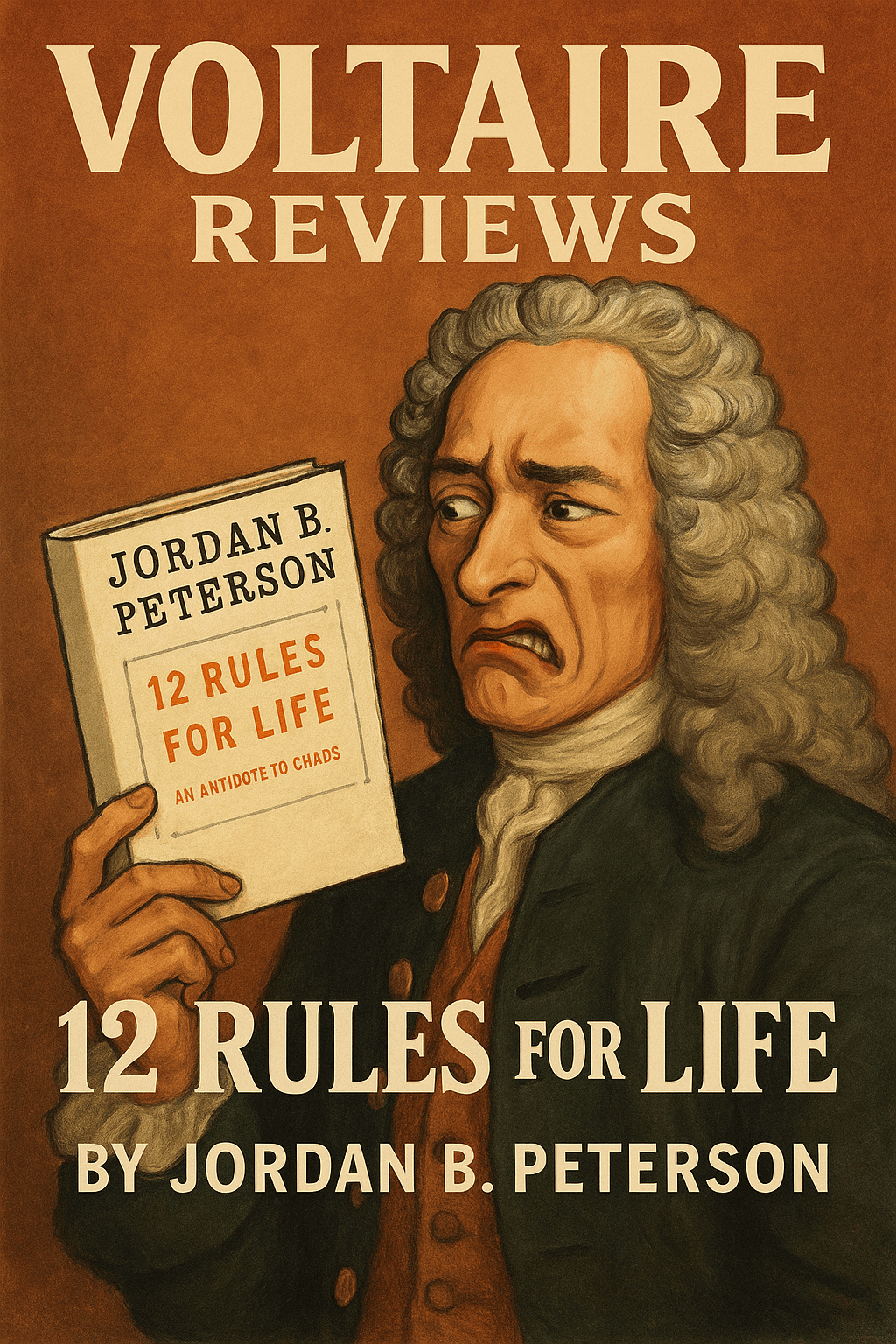
It is a curious thing to observe, from the other side of mortality, that men still reach for order in times of confusion and yet insist on finding it in the most long-winded places imaginable. Enter Dr. Jordan B. Peterson, a Canadian psychologist who has, with this book, taken it upon himself to rescue the flailing modern soul from the evils of chaos, meaninglessness, and untucked bedsheets. 12 Rules for Life is presented as a practical guide to living, but it reads rather more like a sermon delivered at gunpoint by a very tired archangel.
The premise is straightforward: the world is messy and unjust, so here are twelve pieces of moral and psychological advice that might help you bear it. Advice like stand up straight, tell the truth, be precise in your speech, don’t bother children when they’re skateboarding, and of course, pet a cat when you see one on the street. Yes, really.
Now, I am no enemy of simplicity. I once said, “Common sense is not so common,” and that was before Twitter. But this book attempts to smuggle dogma in through the servants’ entrance, dressing up biblical allegory and rigid hierarchy in the language of psychology.
Of Lobsters and Men
One of Peterson’s most famous metaphors — and he repeats it like a holy mantra — is that of the lobster. Lobsters, he informs us, establish social hierarchies and dominance displays, much like humans. Therefore, we should stand tall and accept that hierarchies are natural, eternal, and good.
Now, I have no quarrel with lobsters. They are delicious and admirably silent. But if we are to build a philosophy of life on the nervous system of a sea insect, we may find ourselves ill-equipped to address, say, racism, war, or the tragicomic farce of 21st-century bureaucracy. “Behave like a confident lobster” is, I suppose, a motto. But it is not a moral compass.
A Protestant Work Ethic, Dressed in Clinical Robes
The deeper one reads, the clearer it becomes that Peterson is not merely offering life tips. He is offering a theology — one rooted in biblical interpretation, Jungian archetypes, and the firm belief that chaos is feminine, order is masculine, and both must be managed with patriarchal firmness.
You see, for Peterson, much of life boils down to suffering. Existence is a burden, and the best one can do is carry it nobly. This idea is not new. It is Calvin in a lab coat. It is Dostoyevsky in a therapist’s waiting room. But here, it is preached with such solemnity that one forgets life also contains joy, pleasure, revolution, and the occasional need to dance.
Where the Advice Fails — And How to Spot It
Now, let us ask plainly: Is there bad advice in this book? Why yes. Not evil advice, mind you — but advice rendered dangerous by what it omits, by how it generalizes, and by the tone of unbending certainty.
Take for example his insistence that “before you criticize the world, put your house in perfect order.” This sounds noble — until one realizes that, by this logic, the poor should not protest, the oppressed should tidy up, and injustice must wait until everyone has folded their socks.
Or consider his refrain that suffering is inevitable and meaning comes from responsibility. Yes, suffering exists. But if you teach a generation that they must simply bear it, you risk producing obedient citizens of tyranny, not revolutionaries of truth.
Worst of all is the book’s moral gravity — the sense that life is so dangerous, so fraught, so precariously balanced on the edge of hell, that a missed chore or a forgotten cat stroking is a symptom of cosmic decline. This is not just overstatement — it is existential hypochondria.
So how does one distinguish good advice from the pernicious?
- If the advice makes you feel more human, more free, more capable of laughter — keep it.
- If it asks you to shrink, submit, or fear the world — set it down and light a candle instead.
- If it cannot be questioned without invoking doom, it is not advice — it is doctrine.
A rule is only wise when it illuminates possibility, not when it chains you to someone else’s fear of disorder.
Wisdom, Buried Alive
Each chapter begins with a rule — a short, pithy maxim — and then meanders for twenty to thirty pages through personal anecdotes, biblical exegesis, evolutionary theory, and speculative psychoanalysis. At times, one suspects the author began the chapter with a rule in mind, forgot it halfway through, and remembered it just in time to conclude.
His advice is not always wrong. But it is so thoroughly buried under metaphor, digression, and moralistic gloom that the reader must hack through it like a jungle explorer just to find the path again. I myself wrote entire treatises, argued against kings, and survived exile in fewer words than he spends explaining why it is noble to do your chores.
What Is Missing
Here is what you will not find in 12 Rules for Life:
- A critique of unjust systems.
- A recognition that structural oppression exists beyond one’s dirty bedroom.
- A sense of humor that does not wilt under the weight of Old Testament dread.
- The slightest possibility that chaos might sometimes be necessary — or even beautiful.
It is a book obsessed with discipline, order, and personal responsibility — all virtues, yes — but offered as a tonic for every ill, which is a bit like prescribing saltwater for every ailment of the soul
Final Judgment (from the Comfort of the Afterlife)
Had this book been written in my time, it would have been applauded by certain bishops, banned by others, and mocked by every satirist with a functioning pen. I, naturally, would have done all three.
There is earnestness here. There is effort. There is even the occasional gem of insight. But the overall effect is that of being locked in a monastery with a talkative monk who once read Nietzsche and never recovered.
12 Rules for Life is not an antidote to chaos. It is an instruction manual for surviving it — alone, grim, upright, and on your best behavior. It is morality by checklist. It is virtue with a scolding finger. It is philosophy for the deeply anxious, and theology for the emotionally repressed.
In the words of a certain 18th-century philosopher: If this is wisdom, may heaven preserve us from too much of it.
Regards,
Voltaire
Voltaire’s Recommended Alternatives to “12 Rules for Life”
For those in search of wisdom without lectures, discipline or dread, or those who simply prefer a lobster free philosophy may I recommend these alternatives:
For those seeking personal strength without sermons:
Discourses and Selected Writings by Epictetus
“He was born a slave, wrote like a sage, and never once compared himself to a crustacean.”
For those tempted by Jungian murk but craving clarity:
The Tao Te Ching by Laozi
“Thirty-seven short chapters of poetic paradox — more useful than five hundred pages of Protestant gloom.”
For those obsessed with cleaning their room:
Walden by Henry David Thoreau
“He went to the woods, not to organize his sock drawer, but to live deliberately.”
For those who want to change the world — not just endure it:
The Fire Next Time by James Baldwin
“A man who spoke hard truths with beauty, rage, and love — and never once blamed the chaos on women.”
For those who still want rules, but prefer them witty and subversive:
The Devil’s Dictionary by Ambrose Bierce
“A book of definitions so sharp, they make commandments blush.”
And, of course, for those who prefer truth in powdered wigs:
Candide by Your Humble Servant, Myself, Voltaire.
“Optimism was the fad of my day. Moral panic is yours. I destroyed the former — you may find this useful in approaching the latter.”
It has war, plague, betrayal, philosophy, sex, and gardening. In short, everything 12 Rules forgot to mention.
